
A great facelift is the one you never notice. When the work is done well, you just think someone looks rested, a little more like themselves on their best day. When it goes sideways, the eye catches it immediately, even if you can’t name exactly what feels off. Understanding facelift results, the potential concerns, and realistic expectations helps people make more informed decisions before they ever book a consultation.
That is exactly the lens The Bossticks brings to beauty and wellness. Lauryn and Michael explore these topics by bringing expert conversations and firsthand perspectives together, so readers understand the procedure, the recovery, and the questions worth asking.
Over the years, the show has sat down with top doctors, surgeons, and skin experts, including dermatologic and facial plastic surgeon Dr. Cameron Chesnut, longtime esthetician Staci Christie, and plastic surgeon and TV personality, Dr. Terry Dubrow.
One thing they stress across the board: focus on choosing qualified professionals, research your options carefully, and remember that every person’s experience and results can be different. Two people can see the same surgeon and heal in completely different ways.
In this post, we’re sharing the highlights of each episode, helping you learn the tell-tale signs of a bad facelift according to professionals.
10 Signs Someone Had a Bad Facelift
A bad facelift can mean a few different things. It may refer to results that look unnatural, complications that show up after surgery, or an outcome that simply doesn’t meet expectations. None of these are things you should diagnose from a photo or a mirror.
It’s also important to remember that while this article is educational, it’s not a diagnosis. For anyone concerned about their own facelift results, consult a qualified medical professional.
With that said, here are the signs that experts and the clinical literature flag most often.
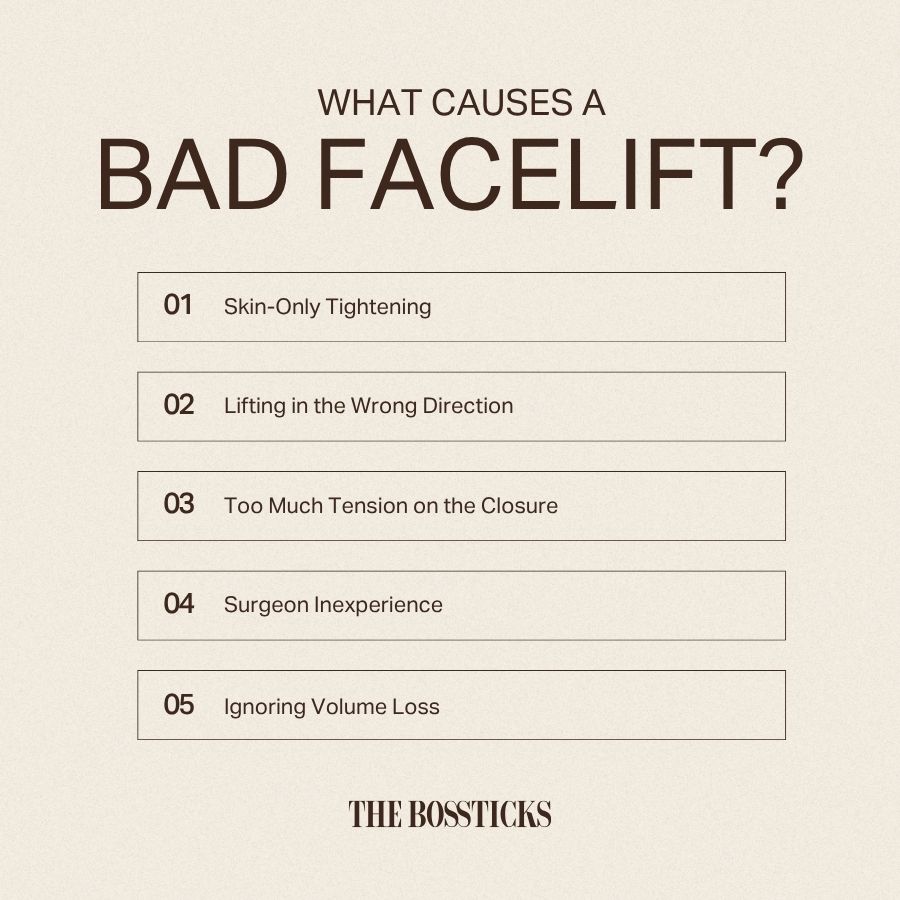
What Causes a Bad Facelift?
Most poor outcomes are not random. They trace back to a handful of specific factors, and understanding them helps you ask smarter questions when you choose a surgeon.
Skin-Only Tightening
This is one of the most common culprits. The use of outdated techniques that rely primarily on pulling the skin rather than repositioning deeper support layers often leads to short-lived results, widened scars, and an unnatural appearance as tension builds along incision lines. The deeper layer of tissue, called the SMAS, is what should be doing the heavy lifting.
Lifting in the Wrong Direction
Direction matters as much as tension. A natural facelift elevates tissues upward and restores youthful positioning. When skin is pulled backward toward the ears, it can flatten the cheeks, distort the mouth area, and create an artificial look.
Too Much Tension on the Closure
Tension is the enemy of a clean result. The tension exerted on the skin closure site is the most significant factor contributing to the development of scars and pixie ear deformity. Anchoring the deeper tissue takes tension off the skin itself.
Surgeon Inexperience
Facial anatomy is layered and unforgiving. Damage to the facial nerve can occur when a surgeon hasn’t been careful in dissecting the deep layers, because facial nerves live within the deeper facial tissue and muscles. It’s not uncommon that inexperienced surgeons unfamiliar with the anatomy can unknowingly and permanently cause nerve injury. This is often the strongest argument for choosing a board-certified specialist.
Ignoring Volume Loss
Aging isn’t just about sagging. Many facelifts fail to address volume loss, which is a key component of facial aging. And, as we’ll discuss below, when a surgeon tightens the skin without restoring fullness, it can leave the face looking harsh or skeletal.
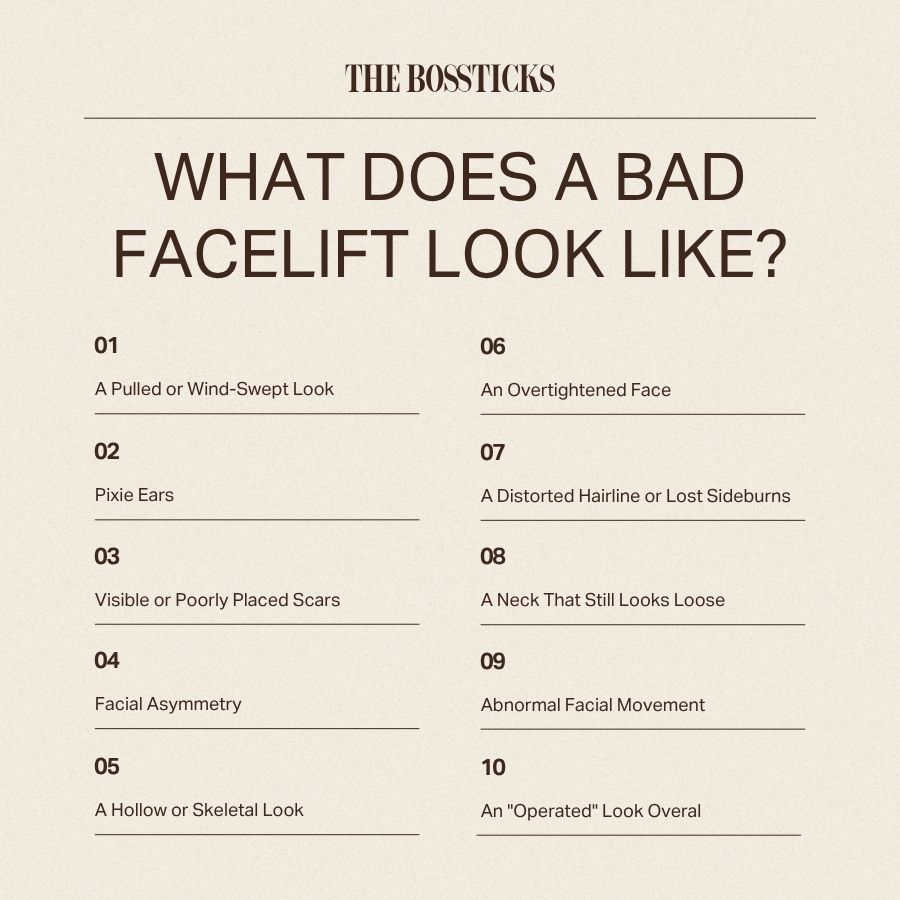
What Does a Bad Facelift Look Like?
A Pulled or Wind-Swept Look
This is the classic giveaway. Common signs of a poor facelift outcome include a pulled or wind-swept appearance, where the skin looks stretched rather than naturally lifted. It happens when the surgeon relies on the skin alone instead of the deeper support layers underneath.
Pixie Ears
You may have heard the term “pixie ears.” This term refers to when the earlobe pulls downward and tethers to the rest of the skin, which indicates that too much skin was removed. The same goes for ears that you can essentially see inside of.
Visible or Poorly Placed Scars
Scars should hide in the natural creases and hairline. When they don’t, it shows. When excessive tension is present, the resulting scar is more likely to be wide, raised, and poorly positioned. Plastic surgeons often say they are judged on the quality of their scars, so this is a big one.
Facial Asymmetry
Some subtle asymmetry is normal on every face. A noticeably uneven result after surgery is different. It can point to how the tissue was lifted or supported on one side versus the other.
A Hollow or Skeletal Look
A facelift shouldn’t leave someone looking gaunt. Hollow cheeks, flattened temples, or a gaunt appearance may occur when fat is removed or repositioned improperly. This is why many modern surgeons focus on restoring volume, not just tightening.
An Overtightened Face
More isn’t always better. When a face is pulled too tight, it reads as artificial. More specifically, when skin is pulled backward toward the ears, it can flatten the cheeks, distort the mouth area, and create an artificial look that draws attention to the surgery itself.
A Distorted Hairline or Lost Sideburns
Incisions that are placed carelessly move the hair. If a surgeon removes too much skin or places the incision incorrectly, the sideburns may be moved too high or shifted behind the ear, making it difficult for patients to wear their hair up.
A Neck That Still Looks Loose
Ironically, a facelift can leave the neck looking untouched. Some patients are bothered by a neck that still appears lax despite facial tightening. The neck has its own components (fat, skin, and muscle) that all need attention.
Abnormal Facial Movement
This is one of the more serious signs and always warrants a professional evaluation. Abnormal motion in the face results from some type of nerve injury, so the facial muscles can be weak or even paralyzed, ranging from a subtle weakness in the lower lip to a complete inability to close the eyes.
An “Operated” Look Overall
Sometimes there’s no single flaw, just a face that reads as “done.” Surgeons call these facelift stigmas. A great result should improve the signs of aging without leaving those surgical footprints behind.
Every person’s healing process is different, and only a qualified professional can evaluate whether a result requires medical attention. If something feels off, that’s a conversation for your surgeon.
How Often Are Facelifts Done Badly?
Here’s some reassuring information: most facelift patients are happy. One study published in Plastic and Reconstructive Surgery found that 97.8% of patients believed their results to be “very good” or “beyond expectations.”
Still, revisions happen. Estimates suggest that approximately 5% to 15% of facelift patients may seek revision surgery at some point. A facelift revision isn’t something you necessarily need to avoid. Instead, it’s simply a corrective or secondary procedure to refine or fix an earlier result.
Surgeon skill is a throughline in the data. Highly qualified, board-certified surgeons are associated with fewer revision surgeries due to their advanced skills and knowledge of best practices.
What to Do After a Bad Facelift
If you’re unhappy with your results, you have options. The worst move is panicking or making decisions before you’ve fully healed.
Wait for Full Healing First
Swelling and bruising always make things feel worse than they are. Even a few days after a facelift surgery, you can still experience significant bruising, swelling, tenderness, and soreness.
When evaluating your result, wait until all the bruising and swelling have completely subsided. What looks alarming at three weeks can look completely different at six months.
Talk to Your Original Surgeon
Start with the person who did the work. Don’t be afraid to ask questions about the plastic surgery you received, note any excess skin you’re unhappy with, and express your general dissatisfaction. A good surgeon wants to know these things. They can also help walk you through what’s normal… and what’s not.
Get a Second Opinion From a Revision Specialist
If you’re still concerned, seek out someone who focuses on corrective work. A facelift revision is a specialized skill, and revision surgeons deal with these exact issues regularly.
Understand What a Revision Can and Cannot Do
Set realistic expectations. Some concerns respond beautifully to revision, others improve rather than fully resolve. It’s important to consider what your surgeon has told you, focus on what you can fix, and be patient with your results. Good things take time.
Listen to The Bossticks to learn more about facelift practices, strategies, and results.
The through-line is the same: the single best way to avoid a bad facelift is to choose a surgeon carefully in the first place. Look at a broad, consistent body of results, ask how much of their practice is dedicated to the procedure, and confirm they operate in an accredited facility.
For more conversations like this with the doctors and skin experts shaping modern aesthetics, subscribe to The Bossticks on YouTube and watch the full episodes.
The Bossticks is informational and wellness focused. Lauryn and Michael are not doctors, dermatologists, or surgeons, and nothing here is medical advice, a diagnosis, or a substitute for care from a qualified professional. Always consult your own physician before making decisions about any procedure.