

There’s a quiet assumption most people carry into an injector’s chair. You get filler, it fades, and a year later, it’s gone. Simple. Except the doctor at the center of this conversation says that timeline is mostly a myth.
Dr. Cameron Chesnut, a board-certified dermatologic surgeon and founder of Clinic 5C, joined The Bossticks for one of the most fascinating conversations on modern facial aesthetics. He covered what actually happens as we age, why the best results are the ones you can’t quite put your finger on, and how the industry’s thinking has shifted over the last decade.
He operates one patient a day, obsesses over recovery, and looks at surgery the way a coach looks at an athlete’s season. And in his episode, he talked to Lauryn and Michael about the question people quietly wonder but rarely ask out loud: “Does old filler dissolve?”
Here’s everything worth knowing from the Cameron Chesnut podcast with The Bossticks, plus a breakdown of the science underneath it.
Old Filler Never Dissolves? What Dr. Cameron Chesnut Says
Dr. Chestnut told Michael and Lauryn that when it comes to filler, the type, timing, and individual factors all matter. For example, hyaluronic acid filler doesn’t act or perform the same as poly-L-lactic acid filler, but not many people know that. It’s not that plastic surgeons aren’t informing patients, it’s that sometimes, they don’t always think to ask.
Ultimately, the goal of the episode (and the post) is to help everyone better understand facial treatments, fillers, and timelines. This way, it becomes significantly easier to have informed conversations before sitting in the chair.

What Are Dermal Fillers?
Dermal fillers are injectable gels a provider places under the skin to add volume, smooth lines, or support facial structure. The most common kind uses hyaluronic acid, a substance the body already makes. This is also why hyaluronidase is the enzyme that dissolves hyaluronic acid.
People reach for injected filler for all sorts of reasons. Some want fuller lips. Others want to replace the volume that naturally slips away from the cheeks and mid-face over time. In the right hands, fillers can restore what’s faded and create natural-looking changes that read as “rested,” not “done.”
On the show, Dr. Chesnut framed his own practice as rejuvenative rather than transformative. He described looking at a photo of a patient from years earlier and aiming for that, rather than reshaping a face into something it never was. That distinction matters, and it runs through everything below.
Why Do People Think Old Filler Never Dissolves?
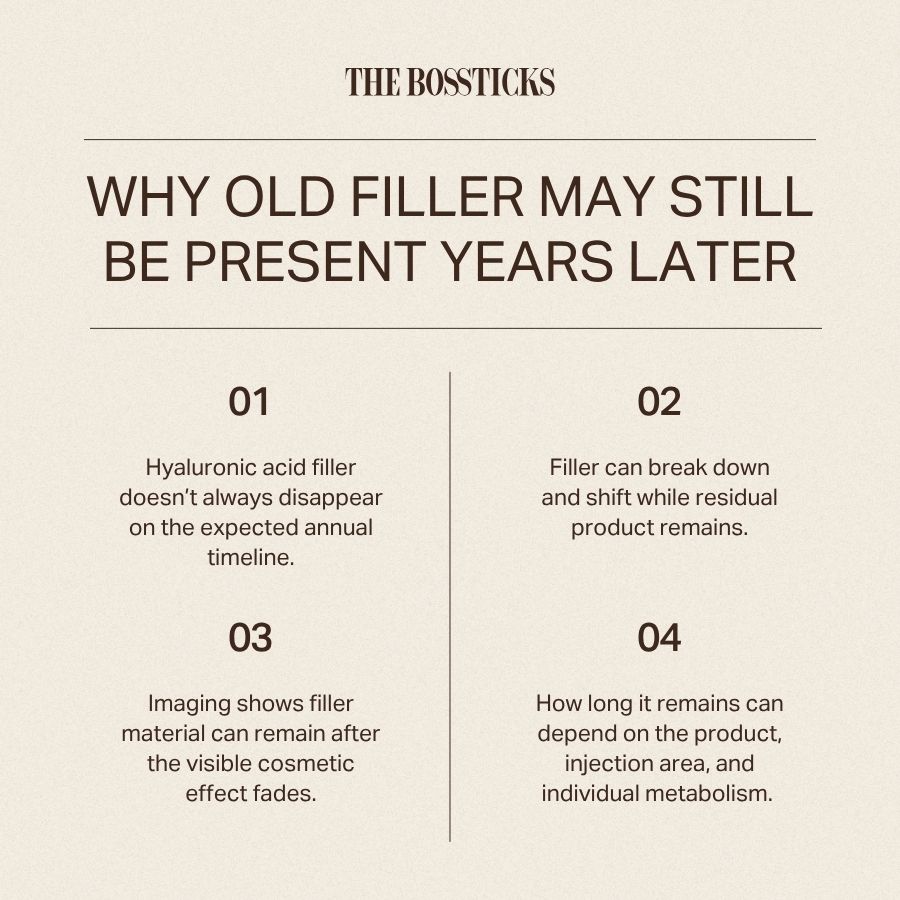
Dr. Chesnut described a 42-year-old patient who had filler in her lips exactly once, twenty years earlier. He could still see it. When he does surgery, he removes filler as a routine part of the procedure, and he estimates it comes up in the vast majority of the faces he operates on.
He continued this point, saying: “The filler from last year isn’t gone. The filler from five years ago isn’t gone.” As he put it, it lasts decades, which reshapes how people now think about getting it in the first place.
Whether filler truly lingers can depend on the type of product used, where it was placed, and individual factors from person to person.
Do Dermal Fillers Dissolve Over Time?
Some do change over time. However, this isn’t a one-size-fits-all conversation.
Dr. Chesnut described how older filler doesn’t just disappear on schedule. It breaks down, moves around a bit, and may stop having the same effect it once had. That’s different from being fully cleared out of the face. The gel changes character while still occupying space.
So yes, filler evolves. But “evolves” and “vanishes” are not the same word, and treating them as interchangeable is where a lot of people start getting confused. The safer assumption is that injected filler has a longer afterlife than the one-year rhythm many were sold.
How Long Do Dermal Fillers Last?
Hyaluronic Acid Filler
Hyaluronic Acid (HA) fillers are probably what you picture when you hear the word “filler.” Think lips, cheeks, and other areas where you want a little extra volume. And for years, people have basically been told that they disappear within a year or so. According to Dr. Chestnut, that’s not necessarily the case.
Research shows that how long HA filler sticks around depends on where and how deeply it’s injected. In some areas of the face, particularly deeper placements, filler can remain much longer than the standard timeline you’ve probably heard. So that automatic yearly retouch? It may not be as necessary as we once thought.
Poly-L-Lactic Acid Filler
Poly-L-lactic acid plays a different game. Instead of simply adding volume with a gel, it stimulates your body’s own collagen production over time. That means you’re not walking out with the full result immediately; it develops gradually as your skin produces more collagen.
Results can last around 18 months, which is part of the appeal for anyone who wants a more gradual, subtle change rather than an instant plump.
Factors That Change the Timeline
Longevity isn’t only about the product. Placement, depth, how much was used, your own metabolism, and how your face ages all move the needle. Dr. Chesnut’s larger observation was that the “reset every year” mindset is outdated, because the material from previous rounds is still contributing long after people assume it’s gone.
Can Dermal Fillers Be Dissolved?
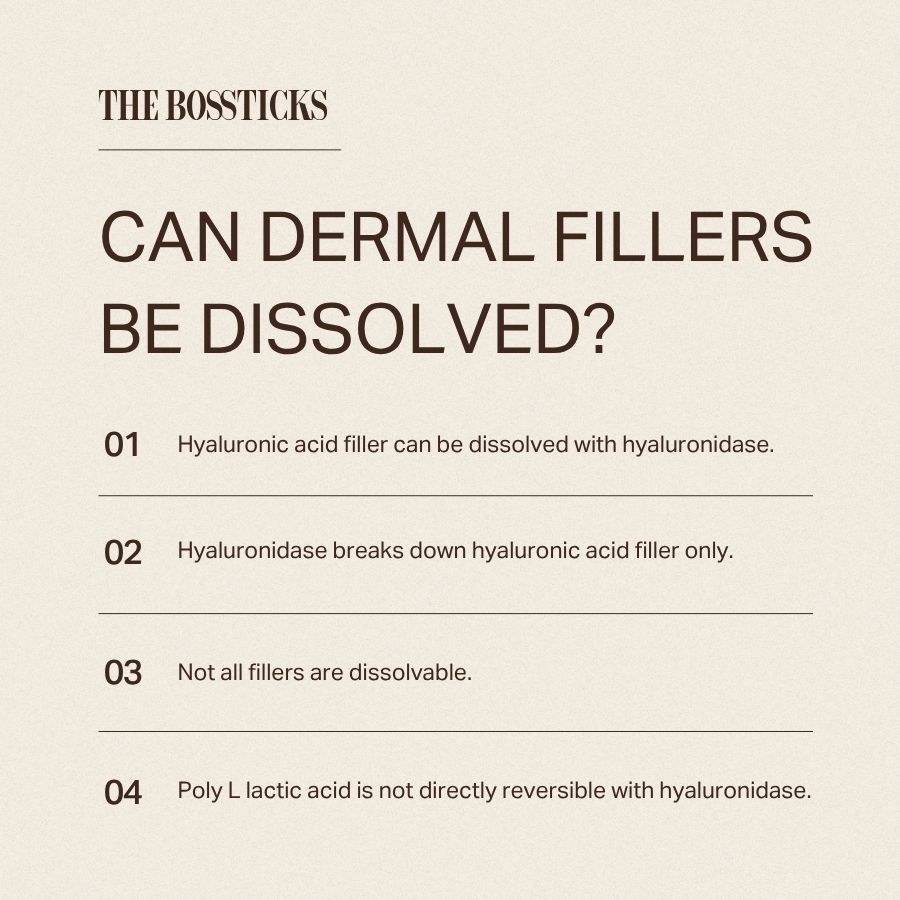
Sometimes, but it comes down entirely to what was injected. This is where filler reversibility becomes the deciding factor.
Hyaluronic acid fillers in particular do have a common reversal method. Providers use an enzyme called hyaluronidase to dissolve fillers, but it only breaks down hyaluronic acid filler. In other words: not all fillers are easily dissolvable.
Fillers like Radiesse, Sculptra, or Bellafill require a different approach entirely, which is one more reason knowing your product matters so much.
What Dissolves Dermal Fillers?
Hyaluronidase
Hyaluronidase is the enzyme most people have heard about when it comes down to dissolving filler. It works specifically on hyaluronic acid fillers breaking it down so the body can gradually absorb it. And it’s not only there for the moments where someone doesn’t want filler anymore. Providers can also use hyaluronidase to address issues like filler migration, overfilling, asymmetry, or certain complications and side effects.
How easily filler dissolves depends on the product, though. Some HA fillers break down more readily than others, while denser formulas may require additional treatment. In other words, dissolving filler isn’t always as simple as one injection and done.
Time and the Body’s Own Process
For non-HA products, and for anyone who simply waits it out, the body’s own immune activity gradually breaks material down over the long term. It’s slower and far less predictable than an enzyme, and as Dr. Chesnut described, “slow” can stretch into years while remnants linger and shift.
How Long Does It Take for Dermal Fillers to Dissolve?
Timelines vary depending on the filler type and the approach used. With hyaluronidase on HA filler, results can move quickly. In most cases, noticeable improvement can be seen within 24 to 48 hours after treatment.
In a controlled setting, looser biphasic fillers can respond even faster, though denser, heavily cross-linked products can take more time and sometimes more than one session.
Left to the body alone, there’s no universal answer at all, which circles right back to the theme of this whole conversation. Assuming your filler quietly exited on a one-year timer is the assumption most worth questioning.
For more about rejuvenative aesthetics, the trio also sat down with skincare expert Staci Christie, another conversation worth your time.
The Bossticks are not doctors or plastic surgeons. This is a wellness and culture conversation, not medical advice, and everything here reflects what came up on the show plus reputable sources. For anything involving fillers, procedures, or your own health, consult a qualified medical professional before making decisions.
What Modern Facial Treatments Actually Reward
If there’s a through-line to pull from the whole conversation, it’s that the smartest people in this space are moving away from constant, indefinite maintenance and toward results that last and read as natural. Dr. Chesnut’s rejuvenative philosophy, his obsession with recovery, and his skepticism of the “top up every year” model all point in the same direction: understand what you’re actually putting in your face, and understand that it tends to stay longer than you think.
That’s the real value of the episode. Not fear, but clarity. Watch the full conversation on YouTube, then subscribe to the show’s channel for more unfiltered conversations with the people quietly shaping wellness, beauty, and business.