
Something has quietly shifted in the way women shop. It’s not just about the product anymore; it’s about whether the brand behind the product actually sees you. The leading brands that empower women of all shapes and sizes are rewriting the rules on representation, confidence, and community, and they’re proving that inclusivity is not a trend to chase. It’s the foundation of a business people trust.
On the show, Lauryn and Michael spend a lot of time asking founders and executives what they actually stand for. The pattern is clear. The best brands do more than make things to sell. They listen to women, reflect real experiences back to them, and build a genuine connection with their audience. That connection is what turns a first purchase into loyalty that lasts for years.
In this post, we’re breaking down the brands doing this work, why it matters, and what to look for when you shop. You can dig deeper into these founders and their stories across the full library of guest conversations on The Bossticks.
The Leading Brands That Empower Women Of All Shapes And Sizes
Before we get to the list, it helps to understand what genuine support even looks like. Empowerment is a word that gets thrown around a lot in marketing. The brands worth your money back it up with structure, not slogans.
A brand can empower women in a handful of concrete ways. Inclusive products come first, meaning a real size range that fits real bodies, not a token extended size buried online. Representation matters too, in the campaigns they run and the women they cast. Then there is leadership, community support, and ethical business practices, the parts customers rarely see but always feel. When those pieces line up, you get a brand women actually rally around.
What Makes a Brand Empower Women?
Empowerment goes far beyond a clever hashtag. Here’s what to look for when you are deciding whether a brand walks the walk.
- A genuinely inclusive size range. Not a “curve” section tucked away, but the same styles offered across the full spectrum.
- Representation you can see. Diverse models, real campaigns, and no heavy retouching. Brands that show different bodies help customers feel recognized.
- Women in leadership. Who’s making the decisions matters. Female founders and executives often build with lived experience baked in.
- Community support. Grants, partnerships, and platforms that give back to marginalized communities and underserved communities.
- Ethical practices. Fair wages, responsible sourcing, and honesty about where they still have work to do.
The through line is action. Inclusive marketing only means something when the products, the pricing, and the people behind the brand match the message. That’s the bar people are holding these brands to.
Why Representation Matters in Modern Branding
When you see your body type, your background, and your experience reflected in a brand, you feel valued. When you never see yourself, the message is that you were never the point.
Representation matters in marketing because it does real work. It pushes back on negative stereotypes and the narrow beauty standards that shaped so many young girls growing up on social media. It also helps women of every size feel comfortable in their own skin. And it quietly builds confidence, one campaign at a time. That’s the heart of true body positivity, and it’s why diversity equity has moved from a nice-to-have to a business essential.
Doing right by women and doing well as a business are not in conflict. They reinforce each other.
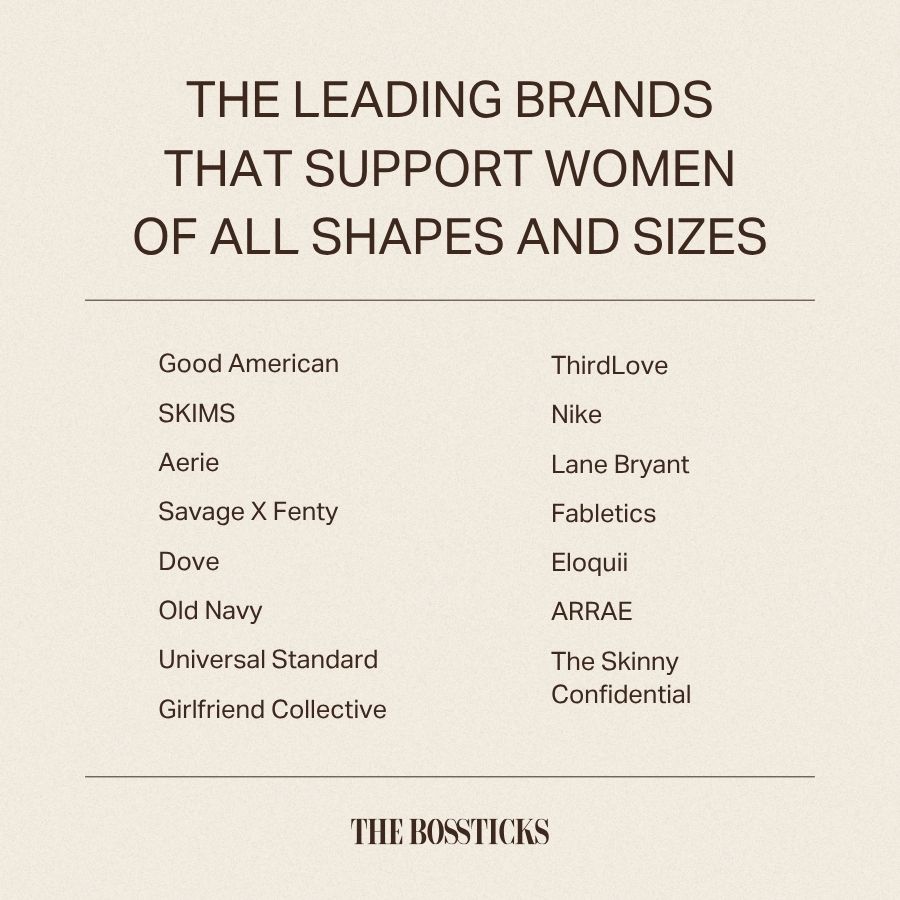
The Leading Brands That Support Women of All Shapes and Sizes
Good American
Good American might be the clearest example of size inclusivity built into the DNA of a company. In 2016, Emma Grede and Khloé Kardashian founded Good American, the inclusive fashion brand offering trend-driven denim designs which has built inclusivity into its ethos, carrying sizes 00 through to 24.
The range has since grown, with denim and ready-to-wear styles in sizes ranging from 00 to 5XL. What sets it apart is that the inclusivity was never an afterthought. In 2018, noting that 50% of their returns were sizes 14 and 16, the brand developed a size 15 to cater to demand.
That’s a company listening to its customers and building for them. You can learn more about the brains behind the brand by listening to Good American CEO, Emma Grede, on The Bossticks.
SKIMS
SKIMS reset expectations for what shapewear and basics could be. Offering one of the most extensive size ranges in the industry, from XXS to 5XL, SKIMS allows individuals of all body types to find pieces that fit comfortably and flatter their shape.
Beyond shapewear, SKMS also helped make shapewear feel less like something women had to hide. Sleek bodysuits, minimal silhouettes, and everyday basics blur the line between functional undergarments and pieces you’d actually feel comfortable building an outfit around.
Aerie
Aerie was one of the first lingerie brands to move away from the “sexy and skinny sells” approach. More specifically, they stopped digital retouching of models in 2014, launching its spokesmodel program in 2016.
And the brand didn’t stop there. Aerie campaigns have since featured women of various body types, some with colostomy bags, wheelchairs and assistive devices, and insulin pumps. That commitment to showing real bodies, including disability, is what makes it credible.
Savage X Fenty
Rihanna’s Savage X Fenty turned inclusivity into spectacle, in the best way. The brand’s runway shows feature models of all shapes, sizes, and ethnicities, and that shift rippled outward. Beyond that, the brand produces lingerie and loungewear that ranges from XS to 3X.
Since Savage X Fenty entered the market, US and UK retailers increased the number of size-inclusive lingerie styles by 34%. When one brand raises the bar, the whole industry has to follow.
Dove
Dove launched its Real Beauty campaign in 2004, a bold response to conventional beauty norms at the time. This campaign targeted women of all shapes, sizes, and backgrounds, promoting a more inclusive and empowering definition of beauty.
Two decades in, the commitment is still evolving. In 2024, the brand pledged to never use AI to represent real women in its advertising, a meaningful line to draw in an era of manufactured images. It hasn’t been without criticism, but the cultural impact is undeniable.
Old Navy brought size inclusivity to an everyday, affordable price point with its BODEQUALITY initiative. Every store offers women’s styles merchandised together with no special sections, alongside inclusive visual cues for shoppers, including mannequins in sizes four, 12 and 18.
The price is the quiet game-changer here. Larger sizes cost the same as smaller ones, which is still not a given across retail. That means shoppers don’t have to pay more simply because they need more fabric, nor are they directed to an entirely different section of the store to find their size.
Universal Standard
Many brands now go well beyond the traditional XXL, and Universal Standard leads the pack with sizes up to 40. The brand was built specifically to serve women who have been left out of standard size clothes. More importantly, the full range is the whole point, not a special collection.
What makes that approach stand out is the consistency. Shoppers aren’t limited to a handful of extended-size pieces while everyone else gets access to the full collection. Universal Standard designs with its entire size range in mind, making inclusivity part of their foundation.
Girlfriend Collective
For sustainable activewear, Girlfriend Collective earns its spot. Girlfriend Collective is a top recommendation for sustainable, inclusive activewear, offering sizes up to 6XL. It pairs a genuinely inclusive size range with recycled materials and transparency about its supply chain, hitting both the inclusivity and ethics markers.
That combination matters in an activewear space that hasn’t always represented the full range of people actually wearing it. Girlfriend Collective brings that representation into everything from leggings to sports bras to everyday basics, proving that shoppers shouldn’t have to choose between finding their size and feeling good.
ThirdLove
ThirdLove built its brand around fit and honesty, launching a campaign titled “New Nakeds,” introducing five nude shades to its basic T-shirt bras. Expanding nude shades sounds small until you realize how long “nude” meant exactly one skin tone. That kind of detail is what supporting women in an underrepresented community actually looks like.
The brand has also pushed for a more individualized approach to bra sizing, offering half-cup sizes and an extensive range of band and cup combinations. Rather than expecting women to squeeze into a limited set of standard sizes, ThirdLove has made finding a more precise fit part of their shopping experience.
Nike
Nike has meaningfully expanded its plus-size offerings, normalizing the idea that athletic wear belongs on every body. The brand’s plus-size ranges have grown significantly, and seeing a major athletic brand cast and outfit larger athletes helps chip away at who gets to be seen as “sporty.” For women who love movement, that representation matters.
It’s also important to note: when representation comes from one of the biggest athletic brands in the world, it reaches far beyond a single campaign or collection.
Lane Bryant
Lane Bryant has served the plus-size community for generations, long before inclusivity became a marketing talking point. Its #ImNoAngel campaign directly challenged the industry’s narrowest standards and gave plus-size women a brand that centered them from the start rather than as an add-on.
That history is part of what makes Lane Bryant different from brands that expanded into extended sizing much later. Plus-size women weren’t a secondary customer; they were the customer.
Fabletics
Fabletics makes trendy, affordable activewear accessible across a wide range with a dedicated plus-size section. The value here is that inclusivity meets affordability, so working out in clothes that fit and look good is not a luxury reserved for one body type.
There’s also something empowering about having actual style choices. Extended sizing shouldn’t mean settling for the one basic black legging available in your size. Fabletics gives more women the freedom to dress for movement in a way that still feels like them.
Eloquii
Eloquii has become a go-to for workwear and special-occassion clothing in extended sizes, offering everything from blazers and trousers to statement dresses. Professional and occasion wear is an area where the plus-size market has historically offered fewer choices. Eloquii stepped in to bridge that gap.
Because here’s the truth: inclusivity matters just as much when you’re dressing for a job, important meeting, wedding, or night out.
Arrae
Arrae was co-founded by Siffat Haider and Nish Samantray, who built the company around real, everyday concerns like bloating, stress, and sleep, with a focus on clean, transparent formulations.
What we appreciate most is the way Arrae talks about wellness without making it about chasing one specific body type. Feeling good in your body can mean supporting digestion, getting better rest, managing everyday stress, or simply finding routines that work for you.
Learn more by listening to the Arrae founders on The Bossticks.
The Skinny Confidential
We would be remiss not to include Lauryn’s own line. The Skinny Confidential grew out of Lauryn’s personal approach to beauty and wellness and has since expanded that philosophy into tools designed to make everyday self-care feel more intentional.
A big part of the brand’s message is that beauty routines are yours to customize. Whether it’s incorporating lymphatic massage, creating a skincare ritual, or finding small ways to prioritize yourself, the focus is less about fitting into someone else’s definition of beauty and more about finding what makes you feel your best.
How To Choose Brands That Genuinely Empower Women
Now that you have the list, here is how to keep evaluating brands on your own. The market moves fast, and new companies join this conversation constantly. Start with the size range. Check the marketing next. Look at who leads the company and whether they give back to their community. And notice the pricing.
Women empowerment in the marketplace isn’t about perfect brands. It’s about brands that show up consistently, listen honestly, and improve when they get it wrong. To go deeper on the founders behind brands like these, watch and subscribe to The Bossticks on YouTube, where Michael and Lauryn sit down with the women building the future across industries.
The content in this post is informational and reflects what we have learned from our guests and our own experience. We are not doctors or financial advisers, and nothing here is medical or financial advice. Always consult a qualified professional before making decisions about your health or finances.