

Children aren’t born with or without resilience. It’s a skill. And like any other skill, it grows through everyday experiences: the small setbacks, the disappointments, the moments that don’t always go perfectly. But here’s the thing: the world isn’t slowing down, so building your kid’s resilience is more important than ever.
Between screens, social pressure, and a culture that praises constant comfort, children need real tools to handle tough times, frustration, and challenges as they grow. These are the exact ideas that came up in the most-talked parenting episodes of The Bossticks.
Lauryn and Michael Bosstick sat down with Dr. Shefali, the founder of the conscious parenting movement, with Lauren Magers on raising world-ready kids, and with parenting psychologist Dr. Becky Kennedy. Each guest approached raising strong kids differently, but they all kept circling back to one idea: strong kids are built, not shielded.
We’re sharing everything these experts explained on the show, plus a handful of practical ways to support your children at home. Make sure to watch each episode for the full conversation, these aren’t ones you want to miss!
How to Build Your Kids’ Resilience & Raise Strong Kids
If building your kids’ resilience sounds intimidating, let us reassure you that the idea is much simpler than it sounds. Building resilience doesn’t mean you have to protect kids from difficult feelings or hard experiences, it’s actually the opposite.
When you jump in to save the day, you teach kids that they can’t handle life’s hard moments on their own. The goal is to help them develop the skills for handling challenges, frustration, disappointment, and setbacks. Those skills and that support is what gives them the confidence to work through tough moments as they grow up.
As Dr. Becky Kennedy put it on the show, kids are born with all the feelings and none of the skills to manage those feelings. As a parent, your job isn’t to remove those feelings. It’s to teach kids the skills to manage them. Catch everything Dr. Becky has to say below.
What Is Resilience for Kids?
In the simplest terms, resilience is a child’s ability to recover after something goes wrong, to keep going after a mistake, and to adjust when life doesn’t match exactly what they planned out.
For kids, this shows up in the simplest of moments, like when a kid loses a game and doesn’t throw a tantrum. They feel the sting, and they move on. It shows up when children experience disappointment, make mistakes, face frustration, or need to adjust to something unexpected.
Dr. Becky described this beautifully with what she calls the “feelings bench.” Every child will sit on hard benches throughout life, like feeling left out or feeling less than others. They won’t build resilience if you yank them off the bench and drag them to another one. Instead, sit down next to them until they can get up and walk away on their own.
Resilience is the ability to keep going when something is hard, not to stop and try to change the circumstances.
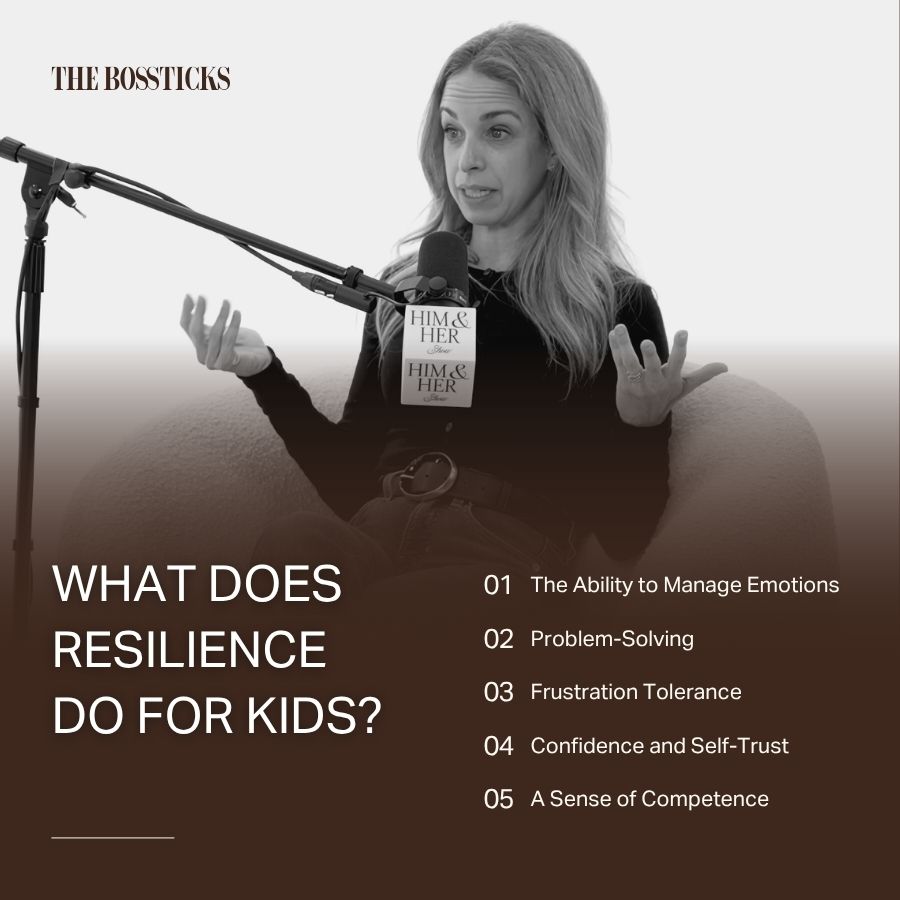
What Does Resilience Do for Kids?
Don’t think of resilience as one single, universal trait. Think of it as a combination of smaller abilities that a child develops and practices over time. Here’s what growing resilience actually builds in your kid.
The Ability to Manage Emotions
When you want your kids to build resilience, you have to help them learn how to manage their emotions. Resilient children begin to understand that they can feel big feelings without being completely overwhelmed. Dr. Becky’s whole approach rests on this idea, that behind almost every hard behavior is a feeling a child has not yet built the skills to handle. When kids learn to sit with frustration or sadness, they stop needing to explode or shut down.
Problem-Solving
Strong kids become solution-based. Rather than collapsing into the “oh woe is me,” they start asking what they can actually do about a situation. Lauren Magers shared a powerful moment about her fourteen-year-old son struggling on the tennis court after losing match after match.
Rather than fixing it for him, she gave him space to process. He came back the next day asking to hire a new coach. That’s problem solving in action, and it’s a muscle children can only develop through practice.
Catch all of the other tips Lauren Magers offered by listening to her full episode on The Bossticks:
Frustration Tolerance
One of the most important skills a child can build is the ability to tolerate frustration, not escape it. Dr. Becky pointed out that as an adult, success is high effort with delayed gratification. Screens, something children tend to spend a lot of time on, teach the exact opposite. Games, social media interactions, TV shows, they all provide instant satisfaction. Learning to wait, to be a little bored, and to stick with something hard is a genuine life skill.
Confidence and Self-Trust
Real confidence isn’t the same as “feeling good all the time.” Instead, Dr. Becky discusses how self-trust is that quiet “I can do hard things” mindset. When a child overcomes challenges on their own, even small ones, they build proof that they’re capable. That is the kind of confidence no one can hand them.
A Sense of Competence
Competence builds confidence. When children are exposed to things that they can actually do for themselves without asking for help, it builds competence. That competence then grows into self-belief. This is why letting a kid struggle with a task they can handle isn’t cruel, and it’s not the same as ignoring them. Instead, you’re teaching them to overcome challenges by themselves.
How to Teach Resilience to Kids
Knowing why resilience matters is one thing. Building it day to day is another. Here are practical ways parents can support resilience through everyday interactions and routines, pulled straight from the conversations on The Bossticks.
Pair Emotional Support With Boundaries
Dr. Becky’s core framework is what she calls “sturdy leadership,” and it comes down to doing two things at once: validating your child’s feelings while holding a boundary. Think of it like acknowledging a fear while also staying in charge, saying things like “I understand this is overwhelming, but I know you can handle it.” One without the other falls flat.
Let Them Experience Manageable Challenges
Dr. Shefali talked about the importance of exposing kids to friction as it naturally shows up in life. If your children lose something, let them find it. If they fall down and cry, let them cry. She says that in a world that offers instant gratification basically everywhere we turn, children can easily grow up to become fragile. They’ve never learned how to actually push through anything. A little measured adversity goes a long way.
Dr. Shefali has a ton of solid points you don’t want to miss, which you can listen to below:
Give Them Room For Independence
Both Dr. Shefali and Lauren Magers emphasized stepping back and letting kids access their own inner voice. Dr. Shefali describes deliberately waiting for a child to make a choice instead of jumping in to fill the silence.
Lauren Magers talked about not talking over your kids, ordering for them, or answering for them. Eventually, they learn to speak up and trust themselves. If you want to encourage your child to be independent, you have to step back and let them build that independence.
Model It Yourself
You know that old phrase, “Do as I say, not as I do?” We know it’s a cliche, but it also has some truth to it. Kids don’t listen to what you say nearly as much as they mimic what you do. If you want a child who can regulate emotions, put down the phone, and handle stress, they need to see you doing it.
Dr. Becky is refreshingly honest, sharing that no parent gets this right all the time. She even goes on to say that fixing a situation after you lose your cool (acknowledging the moment and apologizing), is a lesson in resilience itself. Being a steady role model is the most powerful teaching tool you have.
Don’t Rush to Make Everything Positive
Dr. Shefali calls this staying with “the isness.” When your kid makes a mistake, you don’t need to make everything better. Sometimes, you just need to acknowledge what happened, share that you make mistakes too, and move on. Not every moment needs a lesson or a cheer. Letting a small failure simply be a small failure teaches kids that mistakes are normal and survivable.
For more on the emotional side of all this, the Dr. Becky Kennedy podcast with The Bossticks goes deep on validation, boundaries, and tantrums. And if you want a different angle, the full conversation on raising emotionally strong kids with Dr. Shefali is definitely worth tuning into.
Resilience Activities for Kids
Children develop resilience from things, practices, and activities that are woven into daily life, not a specific rulebook. Here are simple, age-appropriate ways to practice at home:
- Let them do age-appropriate chores. Making the bed, clearing a plate, or putting away dishes builds competence and a sense of belonging on the family team.
- Practice waiting. Try screen-free meals and let kids sit with a little boredom. Dr. Becky suggests starting with one minute and building up over time.
- Assign small responsibilities. Give kids something they own, like feeding a pet or packing part of their own bag, so they learn follow-through.
- Let them find lost items. If something goes missing, resist replacing it right away. Let them problem-solve first.
- Name emotions together. Ask what they are feeling and validate it before moving to solutions. This builds emotional awareness.
- Take a family walk without phones. Let kids carry their own scooter or backpack the whole way, a little friction Lauryn and Michael talked about doing with their own kids.
- Cook a meal together. Let a picky eater become the chef. Teaching kids to prepare food builds patience, independence, and real life skills.
- Roleplay tricky moments. Practice saying “thank you” or greeting a new person at home first, so they build the skill before the real situation.
- Let mistakes stand. When something goes wrong, resist the urge to fix or sugarcoat. Let them process, recover, and try again.
Why Raising Resilient Children Is The Real Goal
At the end of the day, happiness isn’t something a parent can force, and trying to force it honestly ends up backfiring. What you can do is raise resilient children who are capable of handling whatever the world throws at them. As Michael put it on the show, the aim is to build world-ready kids who aren’t blindsided when life turns out to be less than fair.
Developing resilience in the face of adversity is a slow, everyday practice, built through hundreds of small moments of support, boundaries, and letting kids do hard things. Lauryn and Michael are the first to admit none of this is easy, and they are learning right alongside their own three kids.
To hear every tip in full and see these conversations for yourself, watch the complete episodes with Dr. Shefali, Lauren Magers, and Dr. Becky Kennedy, and subscribe on The Bossticks YouTube so you never miss a Monday or Thursday drop.