

Parenting today is genuinely hard, harder in a lot of ways than it was a generation ago, and every single parent makes mistakes. Not “if” mistakes. When mistakes. The phone handed over too early, the snapped comment at the dinner table, the promise broken because work ran long.
This post isn’t here to shame anyone. It’s here to name the most common parenting mistakes that three brilliant experts pointed to when they sat across from Lauryn and Michael on The Bossticks, and to walk through how a parent can actually grow from each one. These insights come straight from real, unfiltered conversations, not from a listicle someone scraped off the internet.
Here’s who weighed in. Dr. Becky Kennedy is a clinical psychologist known for her “good inside” first-principles approach to parenting, and she joined the show to break down why so many of us parent through behavioral control instead of skill-building. Dr. Shefali is the founder of the conscious parenting movement, and she came on to talk about why parents today are raising fragile kids and how to raise emotionally resilient ones instead. And Lauren Magers rounded out the trio, a family-dynamics and leadership coach who spent 15 years building a system for raising world-ready kids.
Three different lenses, one shared honesty. This post is dedicated to every parent who wants to do a little better without beating themselves up in the process.
3 Parenting Mistakes According to 3 Parenting Experts
A quick orientation before we dive in. Every mistake below is common, every one is fixable, and every one comes from an expert who has spent years, in some cases decades, in this exact work. None of these are theoretical. They came up because parents are living them daily, often without realizing the long-term cost to a child’s confidence, emotional regulation, and mental health.
Think of what follows as a mirror, not a scorecard. The mistakes parents make most often are rarely about a lack of love. They’re about missing tools. So here are three of the most common mistakes parents make, straight from the experts who named them:

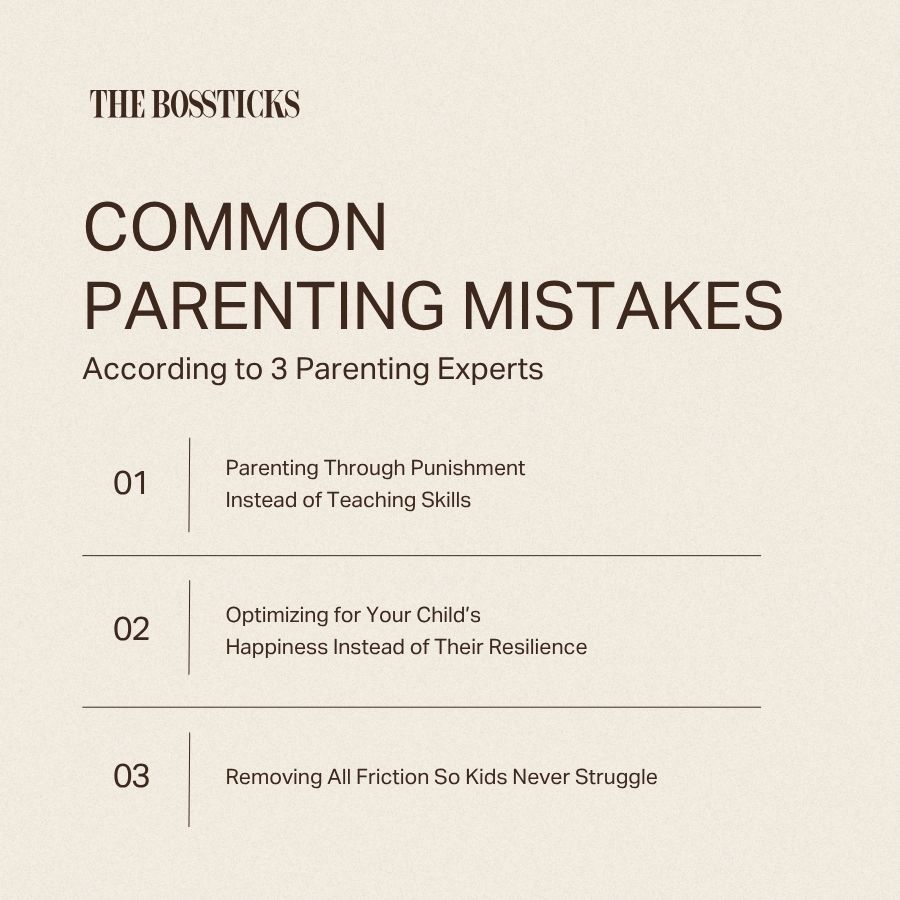
Mistake One: Parenting Through Punishment Instead of Teaching Skills (Dr. Becky Kennedy)
Dr. Becky’s core insight is deceptively simple. Kids are born with all the feelings and none of the skills to manage those feelings, and feelings that don’t have skills come out in bad behavior. When we punish that behavior, we’re essentially punishing a child for not yet having a skill nobody taught them.
She noticed this because her therapy work with adults was the polar opposite of what she was telling parents to do with kids. Every time our kids struggle, our first reaction is to take something away. And if they do anything good, we feel we have to reward them or give them a sticker chart, which is raising kids through a method of behavioral control.
The problem, in her framing, is that this builds compliance, not capability. It also skips the actual relationship, which is where trust with your child is built.
Why it matters for mental health: a child who is sent away every time they melt down doesn’t learn to manage frustration. They learn to hide it. And, even as adults, hiding our feelings isn’t great for general quality of life, regardless of your age.
Dr. Becky’s alternative is what she calls being a “sturdy leader,” the parent who sets a boundary and stays connected at the same time. She uses the example of a child demanding ice cream for breakfast, where a sturdy parent validates the want, holds the line, and doesn’t crumble or explode. That combination of setting boundaries while staying connected is the whole skill, and it’s one worth watching her walk through in full.

Mistake Two: Optimizing For Your Child’s Happiness Instead of Their Resilience (Dr. Shefali)
Dr. Shefali named a parenting warning sign that sounds almost heretical: wanting your kid to be happy all the time.
Parents believe that a good parent raises happy children. They get so invested in wanting their children to be happy that it sends the message that children should feel ashamed if their life is in the gutter right now.
Her deeper point is about identity.
The overarching error is identifying with how your child turns out as something about you and your status. When you do this, every fall becomes something you take personally rather than understanding the child is here to manifest their own journey through the falls and failures.
When a parent’s ego is fused to the child’s outcome, the child gets squeezed. Dr. Becky, interestingly, echoed this from a different angle, arguing that raising kids to feel resilient matters more than raising them to feel happy in any given moment. Emotional, psychological, and social confidence doesn’t come from an unbreakable positive outlook.
Constantly rescuing a kid from discomfort teaches them that discomfort is an emergency. Dr. Shefali’s fix is honoring a child’s essence rather than contouring it into something “spectacular,” and letting kids sit in hard moments instead of wrapping every dropped egg in a bow. Her framework for raising emotionally strong kids by honoring their true nature is the throughline of the whole conversation.

Mistake Three: Removing All Friction So Kids Never Struggle (Lauren Magers)
Lauren Magers’ approach starts with a bigger question: are you just trying to get through today’s behavior, or are you preparing your child to handle life without you?
Throughout her conversation with Lauryn and Michael, she comes back to the ideas of raising “world-ready” kids. That means giving children structure, responsibilities, boundaries, and opportunities to do things for themselves instead of constantly stepping in to manage the outcome.
One example is contribution at home. Lauren doesn’t view making the bed, putting away dishes, or taking out the trash as tasks parents need to reward kids for completing. She frames them as ways children learn that they have a role in the family. When kids understand why they’re contributing, she argues, those everyday responsibilities can help build ownership, belonging, and confidence.
The goal isn’t a child who behaves perfectly because a parent is always directing them. It’s a child who gradually learns how to make decisions, contribute, solve problems, and trust themselves. For Lauren, that’s what being “world-ready” is really about.
Across all three experts, one warning sign kept surfacing: kids who cannot tolerate frustration. That fragility is a genuine risk factor for later struggles in high school and adulthood, and the research community broadly, including bodies like the American Psychiatric Association and the Substance Abuse and Mental Health Services Administration, has long connected poor coping skills and childhood adversity patterns to a range of mental health conditions and mental disorders later in life.
How to Move Forward After a Parenting Mistake
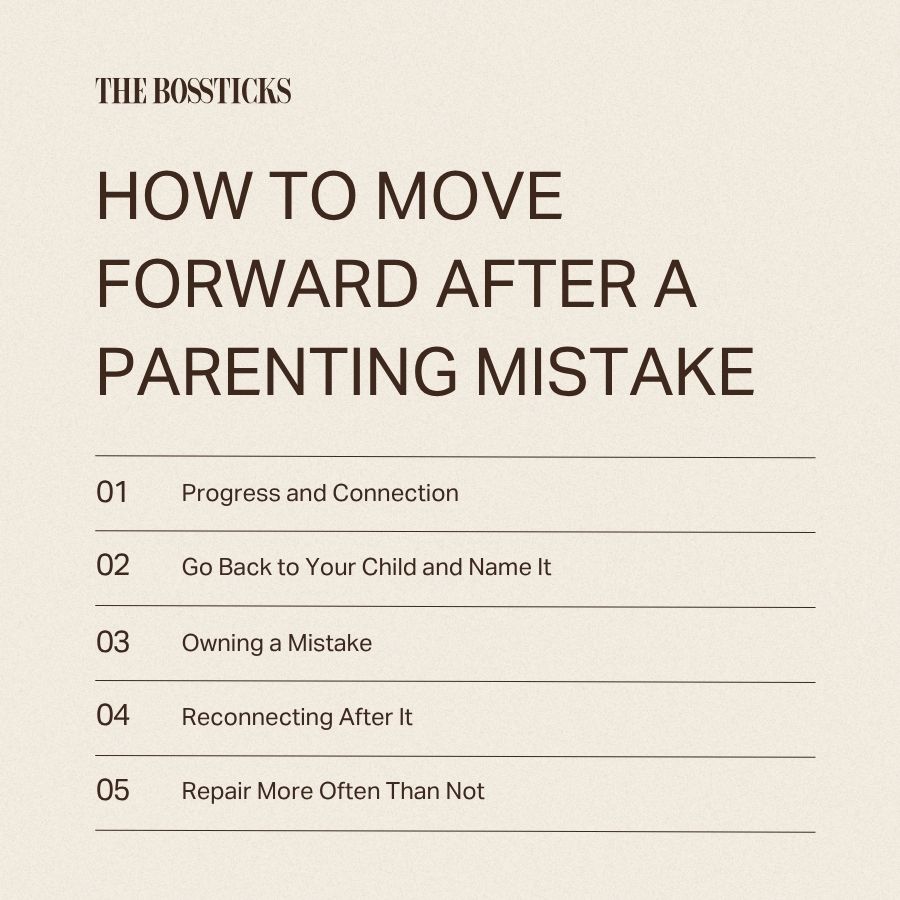
Here’s the part nobody says out loud enough. You’ll make every one of these mistakes, probably this week. The goal was never perfect parenting. The goal is progress and connection.
Dr. Becky’s whole model runs on this. No parent does any of this good stuff all the time, and what kids need is imperfect parents who repair, and who repair more often than not.
What does repair actually look like? Keep it simple and real. Go back to your child and name it. A simple “I’m really sorry I yelled, it’s never your fault when I yell” is the essence of a good repair.
You’re not groveling and you’re not over-explaining. You’re modeling the exact skill you want them to have: owning a mistake and reconnecting after it. That single habit, done consistently over a long time, does more for the parent-child bond than any perfectly executed morning.
How to Forgive Yourself for Parenting Mistakes
Let’s address the guilt directly, because so many parents get stuck spiraling about the biggest parenting mistakes but never actually repair anything at all.
One of the things that gets in the way of repair is the way we chastise ourselves after we yell, for example. It feels so eviscerating to face the reality of what you did that you actually just avoid it, and everyone suffers.
Read that twice. The guilt spiral is not the same as accountability. It’s actually what blocks accountability. Now the truth on how to fix parenting mistakes? Separate who you are from what you did. Repair starts by saying to yourself “I’m a good person who yelled at my kid.” You’re not spotlighting your biggest mistakes and punishing yourself (or even a potential mental health problem) for them. You’re acknowledging something you did wrong and giving yourself the power to grow from it.
Interestingly, even Dr. Shefali noted how universal this guilt is, pointing out that parents feel like they’re constantly guilty for something. And on working-mom guilt specifically, she offered a golden rule: do what gives you true joy and presence, so that when you are with your children, you’re actually there.
So if you’re carrying guilt tonight, hear this plainly. Feeling guilty about your parenting mistakes is normal, it’s nearly universal, and it does not make you a bad parent. It usually means you care. Name the mistake, forgive yourself out loud, and get back to connection.
Listen to the Full Conversations on Common Parenting Mistakes
Every one of these experts said far more than we could fit here, and the full conversations are where the real depth lives. If you want the complete playbooks, sit with each one.
Start with the Dr. Becky Kennedy podcast with The Bossticks for her full breakdown of sturdy leadership, tantrums, and self-repair. Then dig into Dr. Shefali’s episode on raising emotionally strong kids and why honoring a child’s essence beats molding them into an ideal. Lauren Magers rounds it out with her system for building world-ready kids from the inside out.
Do yourself one favor before you go: pick just one mistake from this list, and one small repair. That’s how change actually starts. Then subscribe on The Bossticks YouTube so the next expert conversation lands right in your feed.
The Bossticks is a show hosted by two business professionals, not doctors, therapists, or mental health professionals. Everything here reflects what the guests shared and what works in these conversations, not medical or psychological advice. For any concerns about your child’s mental or physical health or your own, please consult a qualified professional.