
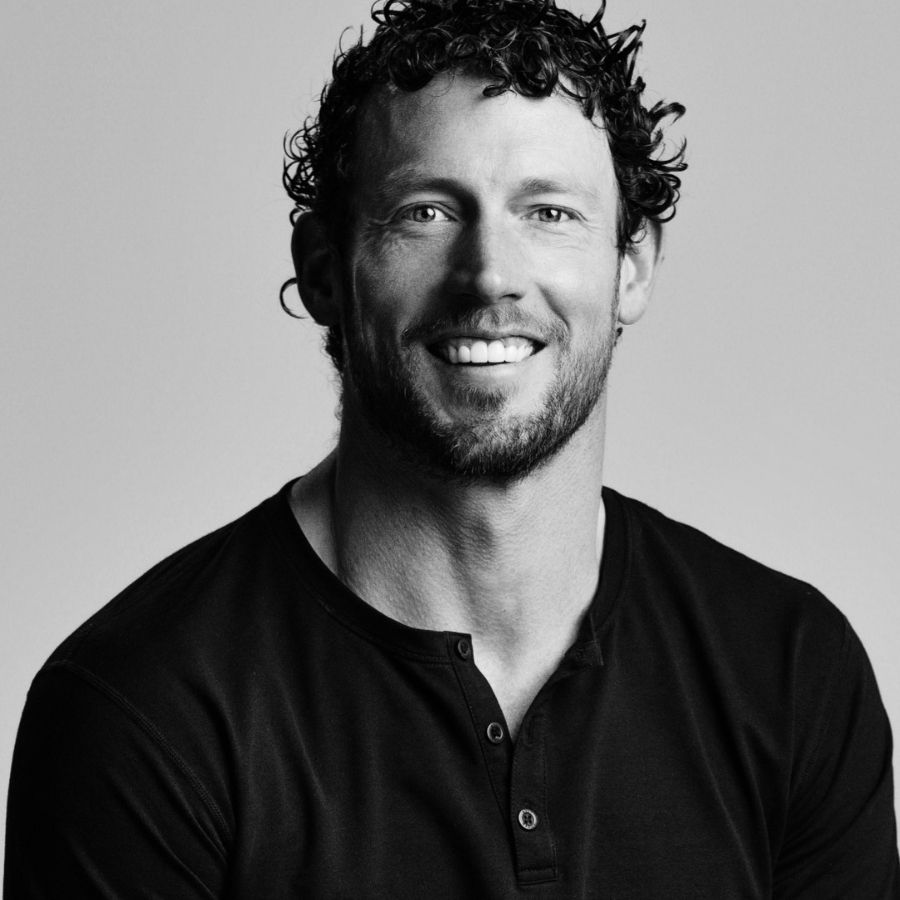
There is a version of cosmetic surgery you can spot from across a room, and a version you can never quite put your finger on. That second kind is exactly what this episode of The Bossticks is about. Lauryn and Michael sat down with Dr. Cameron Chesnut, a surgeon whose entire philosophy centers on results so subtle that even the patient looks in the mirror and thinks, “This looks better, but I don’t know why.”
So who is Dr. Cameron Chesnut, and why does his approach to facial aging feel so different from what most people picture when they hear “facelift?” The conversation moves through what makes a facelift look obvious, why younger people are quietly opting in, how fat transfer works, what filler really does over decades, and the recovery protocols he builds around each patient. His goal is never to change who you are, only to restore how you already feel on the inside.
This post breaks down the highlights of the show’s conversation with Dr. Chesnut, from his credentials to his most memorable takes on aging gracefully. Watch the full episode here for every detail:
Who Is Dr. Cameron Chesnut?
Dr. Cameron Chesnut is a board-certified dermatologic surgeon and the founder of Clinic 5C in Spokane, Washington, renowned for his expertise in nonsurgical and minimally invasive cosmetic procedures, and considered a national authority on aesthetic rejuvenation.
On the show, he explained that he’s been performing facial procedures for roughly thirteen years, and that narrow focus is the whole point. When most surgeons think about a brow lift, he told Lauryn and Michael, there is one standard version they perform on everyone. In his head, there might be multiple different ways to approach it depending on the face in front of him.
His practice is built almost entirely on before and after photos, which he credits to social media. Patients find him the same way Lauryn did, through the algorithm serving up his real results.
For the full conversation, listen to the Dr. Cameron Chesnut podcast with The Bossticks, where he walks through his philosophy in his own words.
Is Dr. Cameron Chesnut a Board Certified Plastic Surgeon?
Dr. Cameron Chesnut, MD, is not board certified in plastic surgery. He’s a double board-certified dermatologist, with board certification in dermatology and the Micrographic Dermatologic Surgery subspeciality. In 2021, he was among the first physicians in the country to achieve certification in the latter.
His surgical training extends beyond dermatology. Dr. Chesnut describes his experience with integrated fellowship training in facial plastic surgery, oculoplastic surgery, dermatologic surgery, and general plastic surgery. As he explained on the show, there are several training pathways that can ultimately lead physicians into facial surgery.
That distinction is important when researching any cosmetic surgeon. Board certification tells you the speciality in which a physician has met specific training and examination standards, while fellowship training can reflect additional specialization beyond that primary field.
As Dr. Chesnut recommends to listeners: look closely at both fellowship training and experience with the specific procedure you’re considering.
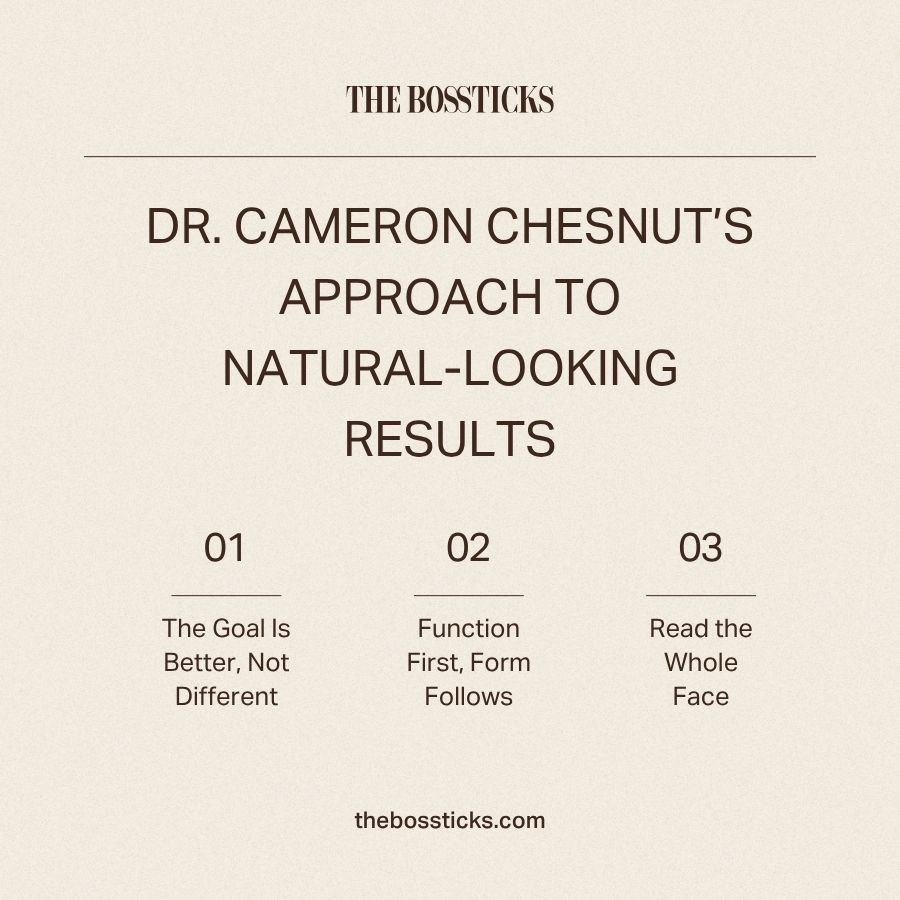
Dr. Cameron Chesnut’s Approach to Natural Looking Results
Dr Chesnut’s entire practice is rejuvenative rather than transformative. He’s not trying to give you a new face. He is looking at a photo of you from the past and working to restore that. Everything else, in his words, follows from function.
The Goal Is Better, Not Different
Dr. Chesnut says he knows his most successful procedures will follow comments like, “I’m exercising and eating well, and now when I look in the mirror, it just doesn’t quite look like how I feel.” That gap is what he corrects. He wants to correct what patients don’t particularly love about themselves without ever triggering the “What did they have done?” comments.
Function First, Form Follows
When someone wants to change their face purely to look like someone else, that’s an immediate no for Dr. Chesnut. About twenty percent of the people who reach out end up being candidates he moves forward with. He’s looking for people whose lives are otherwise in order, not those chasing a photo of a face that’s not their own.
Reading the Whole Face
On the show, Dr. Chesnut assessed Lauryn and Michael in real time. By doing so, he points out that when performing face lifts, he’s not looking at one particular area; he’s looking at the entire face as a whole. For example, an eyelid concern is rarely about the eyebrows alone. Instead, it’s about how the face moves, droops, and drapes with aging. This is core to his practice, reading how each feature affects the entire face.
How Facelifts Have Evolved
Facelifts have changed dramatically. Dr. Chesnut is clear that it’s technique, not technology, driving the shift. Older approaches started with simply cutting and pulling skin, which produced the telltale signs everyone recognizes. He described the “sweep,” a tight sweeping line from the corner of the mouth to the ear that happens when the lower face is pulled too tight while the upper face keeps sinking.
The evolution has been rapid over just the past five or six years, largely because techniques spread faster now. Surgeons can see results on video, adopt new methods quickly, and refine them over time. His own dermatologic surgery background feeds into this constant refinement.
He’s also seeing younger patients, and he made a thoughtful case for why.
Doing something earlier can buy time, because younger tissue and fat pads are as strong as they’ll ever be. It also requires less surgery. On younger patients particularly, Dr. Chesnut notes that he often uses a scarless technique with a tiny access point hidden in the temple, addressing the whole face without any incision in front of the ear. As a caveat, he stressed he’s not pushing young people toward surgery, but rather explaining his unique technique.
This is why personalized plans matter so much. There’s no single facelift he performs on everyone who walks through the door.
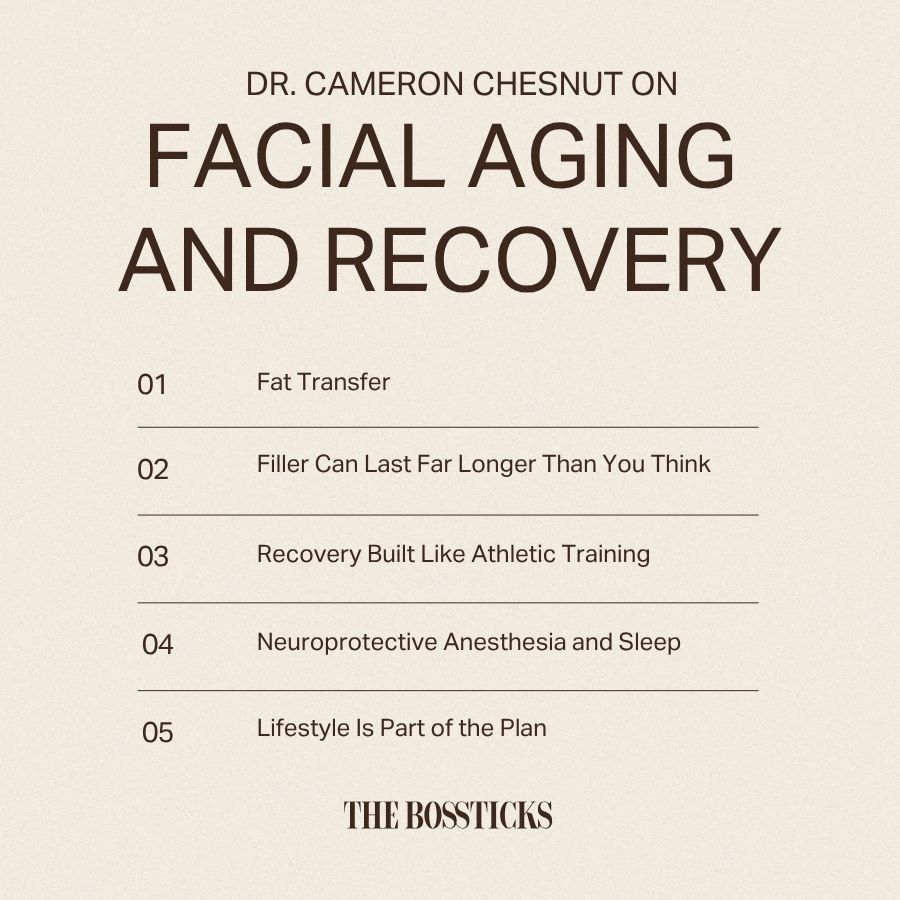
What Dr. Cameron Chesnut Says About Facial Aging and Recovery
Some of the most fascinating parts of the episode came from Dr. Chesnut’s takes on aging, filler, fat, and recovery. Here are the highlights:
Fat Transfer, the “Fat Connoisseur” Method
Lauryn called him the fat connoisseur, and he leaned into it. He borrows fat from areas like the abdomen or thighs, isolates a stem-cell-dense portion, and even places it under red light to activate the stem cells before use. He then puts a smaller amount back into the facial fat pads. He continues to elaborate by saying that if he takes out forty cubic centimeters of fat, he might only use ten.
Filler Lasts Far Longer Than You Think
One of the biggest myths he addressed is that filler dissolves within a year. In reality, he explained, filler can last decades. He described a forty-two-year-old patient who had filler once, twenty years ago, and he was still removing it during her surgery. As it breaks down, it attracts more water and, as he says, can “balloon up” over time. This is one of the many reasons he often removes old filler and replaces it with fat.
Recovery Built Like Athletic Training
Dr. Chesnut treats surgery as a metabolic injury and his patients like athletes. He preps them for weeks or months beforehand to lower inflammation and get them metabolically ready. Recovery happens in-house at his retreat homes, with daily check-ins, hyperbaric oxygen, IV nutrition, and red light therapy.
Neuroprotective Anesthesia And Sleep
His anesthesia approach is one of the most distinctive things he discussed. He was careful to note that general anesthesia is a miracle of modern medicine and is remarkably safe. However, his point is that for an elective cosmetic procedure, he doesn’t need to push the brain that far.
He uses long-acting nerve blocks so that about 95% of his patients never take a pain pill, and he prioritizes restoring healthy sleep as fast as possible. Because, as he told Lauryn and Michael, good sleep does more for recovery than anything else.
Lifestyle Is Part Of The Plan
Michael’s instinct that weightlifting supports facial structure got an enthusiastic yes. Dr. Chesnut connected it to signaling molecules like myokines from lifting and BDNF from exercise, which he tries to activate before patients ever reach him. His whole model is what he describes as “pre-covery,” preparing for stress before it arrives.
A quick note on how The Bossticks handles all of this. Lauryn and Michael are not doctors or surgeons, and nothing here is medical advice. This is a conversation with an expert, shared so you can learn and ask better questions. Always consult a qualified physician before making any decision about a cosmetic procedure.
If skin quality is more your focus than surgery, the show also went deep on that topic. Explore these dermatologist skincare secrets from another expert guest for the routines and ingredients that actually move the needle.
Watch The Bossticks to listen to everything Dr. Cameron Chesnut had to say.
The highlights only scratch the surface. Dr. Chesnut is a rare guest who can explain complex facial plastic surgery in a way a total beginner can follow. The full conversation is packed with the kind of tangible, ask-better-questions detail that The Bossticks is built on. Watch the complete episode on YouTube, then subscribe to the channel so you never miss a conversation like this one.